
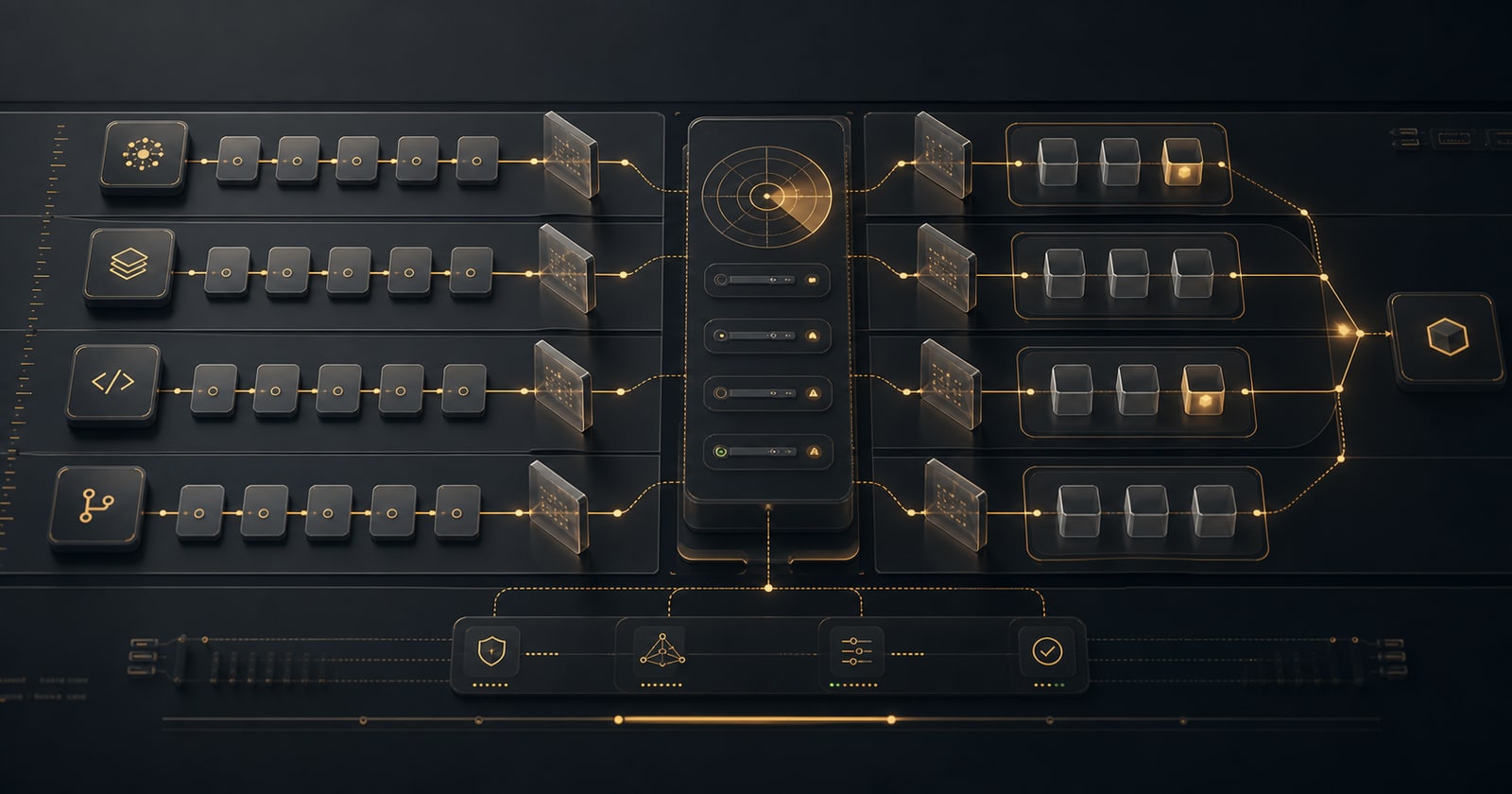
Parallel AI agents feel like free throughput until the first collision. Two agents touch the same registry. A supervisor loses track of which task owns which file. A shared changelog becomes a merge-conflict factory. The work still looks busy, but the system has stopped being faster. It is now producing coordination debt.
The answer is not fewer agents forever. The answer is air-traffic control: sequencing, file ownership, wave gates, and a hard concurrency ceiling. Parallelism is an operating model, not a button.
The dangerous version of parallelism
The dangerous version starts with enthusiasm. Split the work, spawn everyone, let them run. Nobody owns shared files. Nobody waits for wave one before starting wave two. The lead edits while also coordinating. Teammates spawn their own helpers. At the end, the branch has code, but nobody can explain which agent made which decision or whether the changes compose.
That is not teamwork. It is unsupervised concurrency over one stateful workspace.
The operating rules
- Plan the dependency graph before spawning workers.
- Run independent work in waves; do not start the next wave until the current one lands.
- Assign single writers for shared files such as registries, content indexes, migrations, and changelogs.
- Keep the supervisor focused on coordination, review, and synthesis rather than direct implementation.
- Cap concurrency to the number of workers you can actually inspect.
The cap matters. A team of four well-bounded agents can outperform ten agents stepping on each other. The limit is rarely model speed. It is the lead's ability to review plans, detect collisions, and verify outputs before the context window fills with noise.
The file ownership test
Before spawning a worker, answer one question: what files is this worker allowed to own? If the answer overlaps with another active worker, either split the file by fragment pattern, appoint one writer, or sequence the tasks. Shared ownership without a protocol is where ghost changes and attribution bugs enter.
The cleanest teams make every agent submit a short plan before editing: approach, files, tests. Reject the plan if it touches unrelated files, skips verification, or mutates shared config without naming the collision risk. That checkpoint pays for itself the first time it prevents a half-day merge tangle.
Series linkage
Part 3 of 10 in Prompt Library to Operating System. Specs make individual tasks executable; orchestration makes many tasks compose.
About AmanERP
AmanERP uses AI agents as engineering leverage, but only under coordination rules strong enough to keep the audit trail readable.